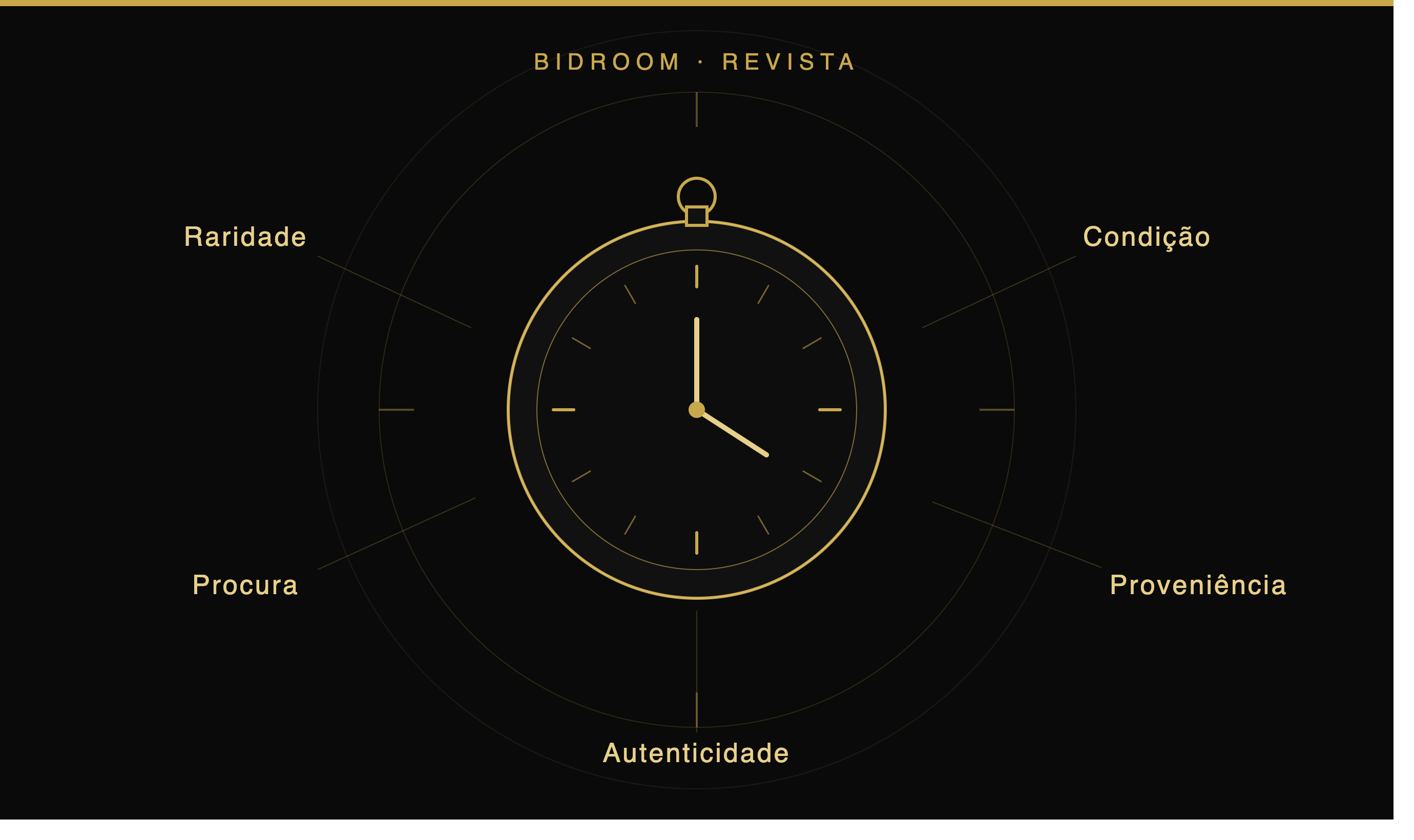
Five factors that separate a genuine collectible from a simply old object — and that every buyer and seller should know.
There's a question that separates seasoned collectors from the merely curious: why can two seemingly similar pieces hold such different values? One watch closes an auction at ten times the price of another from the same year. A painting by a lesser-known artist outsells one by a celebrated name. The answer rarely lies in age or beauty — it lies in a set of factors you learn to recognise. Here are the five that matter most.
1. Rarity — but the right kind of rarity
Instinct says the rarer something is, the more valuable. That's true, but with a nuance: rarity only counts when someone wants it. A unique object that nobody seeks isn't worth more for being unique. The rarity that moves prices is that of pieces many want and few exist — a reference produced in limited numbers, a discontinued series, a specific variant that escaped mass production.
Learning to tell "rare and sought-after" from "merely unusual" is perhaps the most valuable skill a collector can develop. It's what separates an investment from a curiosity.
2. Condition — state matters more than you'd think
Between two identical pieces, the value gap between one in pristine condition and one that's worn can be enormous. But beware an important paradox: in many categories, the market values original condition more than restored perfection. Furniture with the patina of years, a piece never "improved," an object that has aged honestly — all of this weighs more than a restoration that erases time.
The golden rule: time leaves marks, and those marks are part of the story. Erasing them can erase value. Before "restoring" a piece, it's always worth asking whether you might be destroying precisely what makes it desirable.
3. Provenance — the documented history
Who owned it? Where did it come from? Is there documentation, records, original papers? Provenance — a piece's history of ownership and origin — is increasingly central to how value is formed. An object with a verifiable, documented history consistently sells for more than an identical example with no known past.
This is especially true as the market matures and values rise. Documentation stops being a pleasant extra and becomes the line that separates trust from uncertainty. For sellers, keeping boxes, certificates and records isn't a detail — it's preserving value.
4. Demand — the factor no one controls
None of the previous factors matter without this one. The value of a collectible is ultimately defined by how many people want it at the same time. And demand shifts — new generations bring new tastes, trends return, entire categories step out of the shadows into the spotlight.
The attentive collector watches where demand is moving, not where it has already been. The pieces that will be valuable tomorrow are often the ones still being "discovered" today — before the wider market pays attention. It's there, in that anticipation, that the best opportunities live.
5. Authenticity — the foundation of everything
Finally, the factor without which none of the others exist: is the piece what it claims to be? In an era when reproductions grow ever more sophisticated, the ability to guarantee authenticity has become the true foundation of collecting. An authentic piece, with its identity proven, sits on a completely different plane from one whose origin raises doubts.
That's why where you buy matters as much as what you buy. Trust in the channel — in the transparency of the process, in verification, in the protection of buyer and seller — is an inseparable part of a piece's value.
The thread that ties it all together
Did you notice the pattern? Four of the five factors — sought-after rarity, original condition, provenance and authenticity — reduce to a single idea: a piece's history is its value. A collectible isn't just an object; it's an object with a verifiable past, an honest condition and a place in a narrative.
For buyers, this means looking beyond appearance and asking about the story. For sellers, it means preserving it and telling it with rigour. And for both, it means choosing a place where that story can be recognised, verified and fairly valued.
That, ultimately, is the promise of a good auction: turning the story of a piece into the price it deserves.
BidRoom is a premium auction marketplace built for Portugal, dedicated to watches, art, jewellery and collectible objects with history. This article is for informational purposes and does not constitute investment advice.